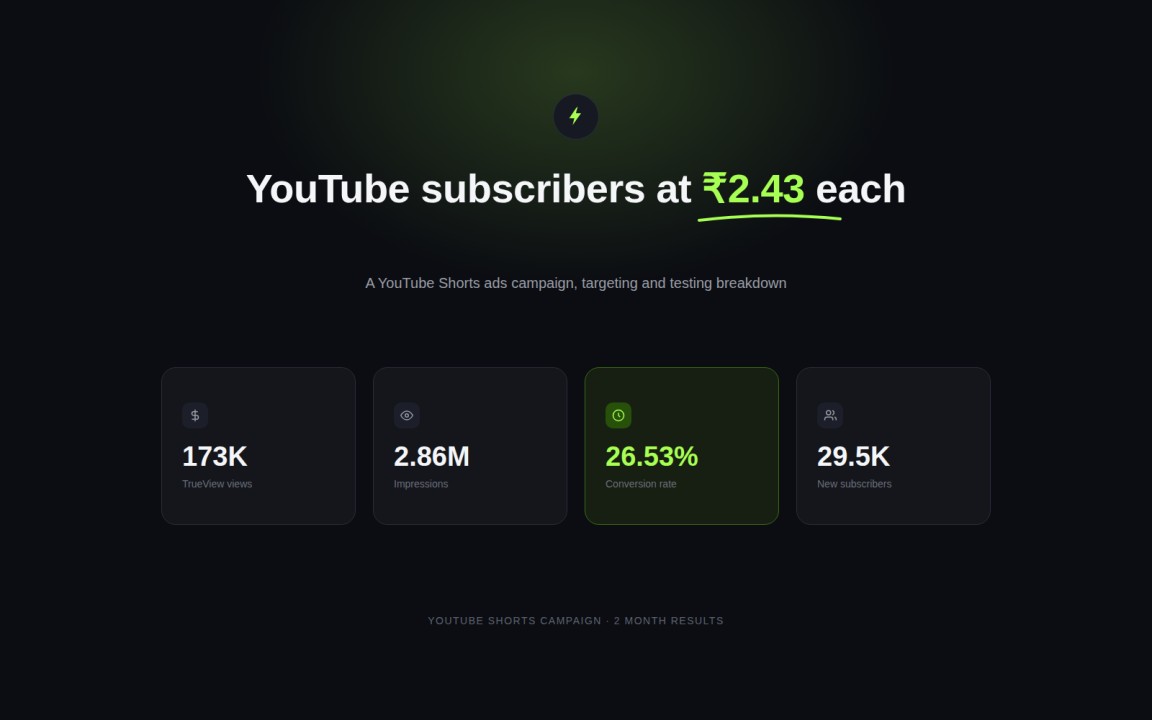
Over two months, a YouTube Shorts ad campaign I ran added 29.5K subscribers at an average cost of ₹2.43 per subscribe, off 2.86M impressions and 173K views, with the subscribe action converting at 26.53% of the people who saw the ad through to completion. The client's identity is under NDA, so the niche stays unnamed here, but the mechanics behind the number are the part worth sharing anyway, since they'd transfer to any YouTube subscriber-growth campaign regardless of category.
This is the actual campaign data:
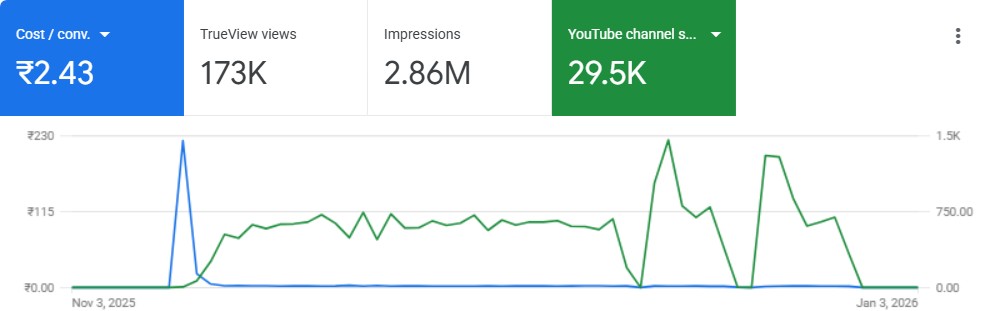
The chart tells a more useful story than the headline number alone. Cost per conversion spikes to roughly ₹230 in the first few days, then drops and stays flat near zero for the rest of the campaign, through two distinct subscriber-growth surges with a flat stretch in between, not one steady climb. Both of those shapes were deliberate, not noise, and explaining why is the actual point of this post.
The format: Shorts ads, not in-stream
The campaign ran exclusively on YouTube Shorts ad placements, not traditional in-stream skippable pre-roll. That choice mattered more than almost anything else in the campaign's performance, for a reason specific to how Shorts inventory behaves: it's short-form, high-volume, low-friction viewing, which means the cost per impression and per view is structurally lower than in-stream placements competing for attention before a long-form video. For a subscriber-growth goal specifically, where the action being optimized for is a single low-friction tap rather than a purchase or a multi-step funnel, that combination of cheap volume and low-friction context is close to ideal. The same budget would have bought far fewer impressions and views on in-stream placements, simply because that inventory costs more per view by default.
Why the first few days were expensive
The ₹230 cost-per-conversion spike at the very start of the campaign wasn't a sign of a broken setup; it's what targeting calibration looks like before Google's delivery system has enough conversion data to optimize against. In the first few days of any new campaign, the algorithm is still learning which specific audience segments, placements, and viewing contexts within the broader targeting actually convert, and early conversions during that window cost more because the system hasn't yet narrowed in on the highest-probability viewers.
Letting that initial spike happen rather than panicking and pausing the campaign was the right call here: the cost curve corrected itself within days once the system had enough signal, and the campaign spent the next several weeks converting at a small fraction of that initial cost. Pulling the plug during the learning phase, a common mistake, would have reset that calibration and likely repeated the expensive start with a different audience configuration.
"The cost curve in week one is not representative of the cost curve once the algorithm has enough data."
– Sooryadas PS
Why custom intent and in-market audiences, started narrow
The targeting approach was custom intent and in-market audiences, set narrow from the outset rather than starting broad and refining down. That's a deliberate departure from a common YouTube Ads pattern, where advertisers often start wide to gather data before narrowing; broad targeting buys cheap impressions early but tends to waste budget on viewers with no real affinity for the channel's content, which is wasted spend on a subscriber-growth goal specifically, since an uninterested viewer costs the same impression budget as an interested one but almost never converts.
Starting narrow meant accepting a smaller initial audience pool and, by extension, a tighter cap on daily reach, but every impression in that pool already had a higher baseline probability of conversion, since custom intent and in-market signals are based on actual recent behavior indicating relevant interest, not just demographic or broad-category overlap. That precision is most of why the eventual cost-per-subscribe number came in as low as it did: the campaign wasn't spending budget to find the right audience through trial and error, it was already targeting people statistically likely to care.
One creative, refined rather than replaced
Unlike a typical A/B testing approach with multiple creative variants running in parallel, this campaign ran on one core creative that was refined iteratively over the two months rather than replaced with entirely new variants. That's partly a budget efficiency call: splitting an already-narrow audience across multiple creative variants reduces the data volume each variant gets, which slows down the learning phase for all of them simultaneously, and partly because the core creative was performing well enough from early on that the marginal gain from testing alternatives against it didn't look likely to outweigh the cost of diluting the targeting's learning data.
What the second surge actually was
The flat stretch in the middle of the subscriber-growth chart, followed by a second surge, wasn't a passive lull; it was a deliberate pause on the original campaign to launch a second sub-campaign with new creative, testing whether the same narrow targeting approach would perform similarly with different creative variables. The dip in the chart is the original campaign winding down before the new one ramped up, and the second surge is that new sub-campaign finding its own footing.
Running this as a sequential test, pausing one before launching the next rather than running both simultaneously, meant the data on the second campaign's performance wasn't muddied by budget competing against the first. It cost some momentum during the transition, visible as the flat stretch in the chart, but it produced a cleaner read on whether the original targeting strategy was reproducible with different creative, rather than the original creative simply being a lucky one-off. And the result on that front is the strongest data point in the whole campaign: cost per conversion stayed flat near its post-calibration low through the second surge just as it had through the first, meaning the new creative converted at essentially the same efficiency as the original. The targeting strategy, not the specific creative, was doing most of the work.
- Shorts inventory buys cheaper, higher-volume impressions than in-stream placements for low-friction conversion goals like subscribing.
- An expensive first few days reflects the algorithm's learning phase, not a failing campaign; let it run rather than pausing early.
- Narrow, intent-based targeting from day one trades reach for a lower blended cost per conversion when the conversion action is cheap and high-volume.
What this means for budget allocation
The practical implication when scaling a campaign like this: once the first run has cleared its learning phase and proven the targeting, the lower-risk sequence is to hold targeting constant and treat creative as the variable worth testing, not both at once. Committing budget to a new creative test before the targeting is confirmed means that a poor result won't tell you which one was responsible, and resetting both simultaneously doubles the learning cost.
What generalizes from this campaign
None of these are universal rules; a campaign optimizing for a higher-friction conversion, or one without enough budget to sustain a precision-targeted audience at sufficient impression volume, might reasonably make the opposite call on more than one of these points. But for a subscriber-growth goal specifically, on Shorts inventory, with a budget that could sustain that audience pool without starving it of impressions, this is the combination that produced a 26.53% conversion rate at ₹2.43 per subscribe.