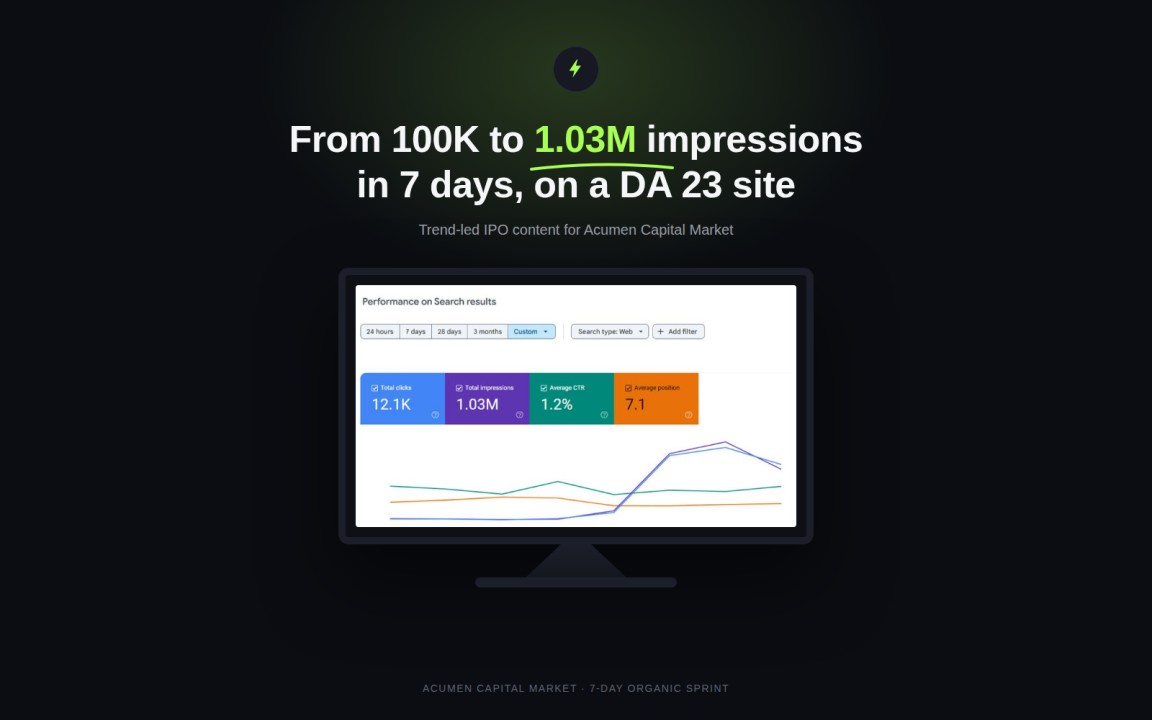
In October 2025, I was running SEO for Acumen Capital Market, a stock broking firm with a Domain Authority of 23, modest in a category dominated by sites with DA 60+ and decades of financial content behind them. In the space of one week, the site went from roughly 100,000 weekly organic impressions to 1.03 million, while holding top-3 positions against publishers with far more domain authority.
For a stock broking firm, organic visibility around IPOs and market events isn't a vanity metric; it's a direct line to the audience most likely to eventually open a trading account. The challenge wasn't simply "grow impressions." It was growing visibility on the exact topics that retail investors search for in the days before and after an IPO opens, on a domain that had none of the historical content depth or backlink profile that the established financial publishers in that space had built over years. That constraint shaped the entire approach below: rather than trying to out-rank entrenched competitors on evergreen finance terms (a fight a DA 23 site has little chance of winning quickly), the strategy targeted a category of search demand where domain authority matters far less: content tied to events that hadn't happened yet.
This is the actual Search Console data from that window:
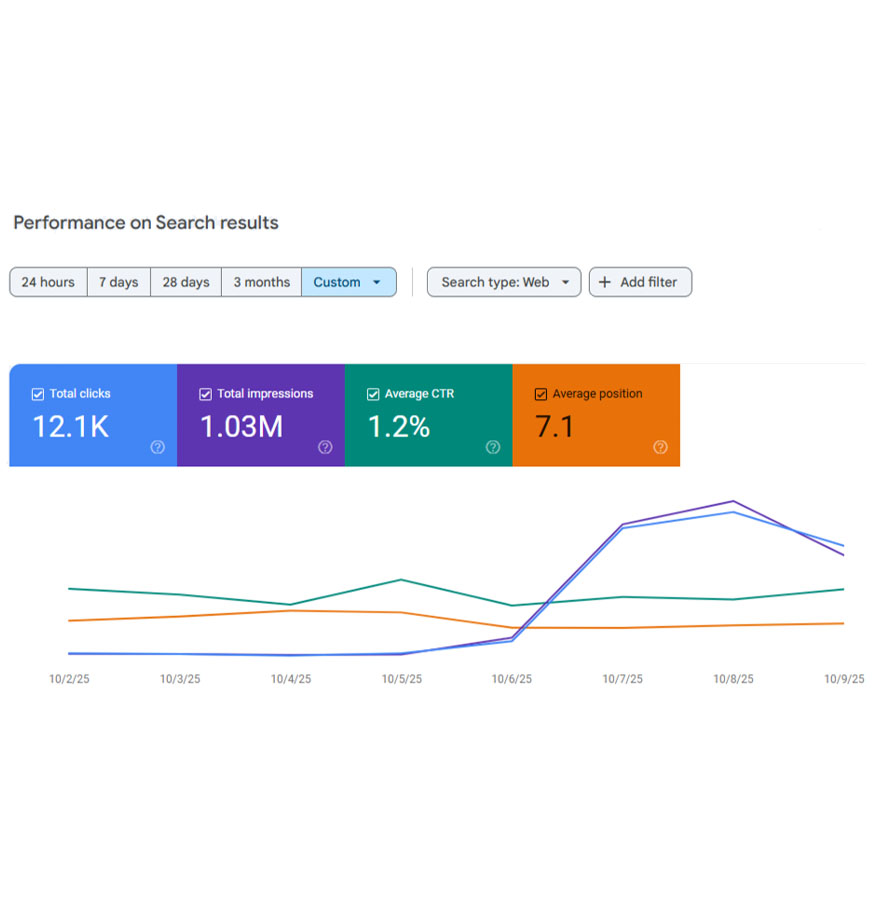
12.1K clicks, 1.03M impressions, a 1.2% average CTR, and an average position of 7.1 across the full keyword set tracked. The CTR looks low relative to the impression count. Why that's a predictable consequence of the content category rather than a ranking failure is covered in full below.
The strategy: trend-led publishing, not evergreen content
The brief wasn't to write the definitive guide to investing; it was to capture demand the moment it appeared. I tracked Google Trends daily inside the business and finance category and published content on emerging topics within hours of a trend spiking, primarily upcoming IPOs and market movements relevant to retail investors.
This is a fundamentally different content model from typical SEO playbooks, which usually optimize for search volume that's already stable and predictable. Trend-led publishing means writing for demand that doesn't exist yet in keyword tools, because the keyword tools haven't caught up to the news cycle. By the time a topic showed reliable search volume in a tool like Ahrefs or Semrush, the opportunity to be first had usually already passed. The edge came from publishing before the demand curve peaked, not after.
Practically, that meant a daily routine: check Google Trends in the morning for finance and business category spikes, identify which ones had genuine retail investor relevance (an IPO announcement, a major market move, a regulatory change) and have a page live within hours, not days. Speed mattered more than depth for capturing the initial spike; depth and topical authority came from doing this repeatedly on the same theme, which is the part that actually built lasting position.
Why low domain authority didn't block this
A DA 23 site competing against DA 60+ financial publishers sounds like a mismatch, and for broad, evergreen finance terms it would be. But IPO-specific and trending-market content operates differently: when a topic is brand new, there's no entrenched incumbent yet. Every site, regardless of domain authority, is starting from the same position on a topic that didn't exist in search a week earlier. Authority differentials matter most when competing for established queries that have been contested for years; they matter far less in the first 48-72 hours of a genuinely new search demand spike, where freshness, relevance, and speed of indexing carry more weight than historical backlink profiles.
What did matter was topical consistency. Publishing IPO content repeatedly, rather than as an occasional one-off, meant Google began to associate the site with that specific sub-topic. That topical authority, not domain-wide authority, is what let the site hold top-3 positions on IPO-related queries despite the DA gap.
"Domain authority wins the fight for old queries. Topical authority and speed win the fight for new ones."
– Sooryadas PS
Why only 12.1K clicks from 1.03M impressions, and why that's not a failure
The CTR-to-impression ratio here needs context, because at a glance it looks like underperformance. It isn't; it's a predictable consequence of search intent mismatch on a specific content category.
Roughly 70% of the published content during this sprint covered upcoming IPOs. The dominant search intent behind most IPO queries isn't informational; it's transactional. The bulk of people searching for a given IPO already know the basics and are trying to find where to apply: they're heading to Groww, Zerodha, or a similar brokerage platform's listing page, not looking to read an explainer. That intent mismatch is structural to the IPO content category; it would apply to any publisher writing about IPOs, not just this site.
Despite that mismatch, the pages held top-3 ranking positions on the strength of topical authority, and, more importantly for the actual business goal, captured an estimated 95% of the purely informational queries around those same IPOs: the smaller slice of searches from people who genuinely wanted analysis, context, or explanation rather than an application link. For a stock broking firm's content strategy, owning that informational segment is the more valuable outcome than chasing clicks that were never going to convert, since the transactional searchers were never going to read an article when their actual goal was reaching a brokerage app.
The headline number worth taking from this case study isn't the click count; it's that 1.03M impressions in a week, on a DA 23 site, demonstrates the visibility ceiling trend-led publishing can reach even when a large share of the underlying intent is unwinnable by design.
The actual workflow, tool by tool
The daily routine ran on four tools, each doing a specific job rather than overlapping.
Google Trends was the discovery layer, checked each morning for spikes in the business and finance category, since that's where a new IPO announcement or market move shows up first, often before any finance publication has covered it in depth. A trend appearing in Trends with rising or breakout volume was the trigger to act, not a confirmation that the keyword was already worth targeting; by definition, breakout volume means historical search-volume tools don't have reliable data for it yet.
Semrush came in next, once a topic was selected, to map the actual keyword variations worth covering in the piece: the different ways people search for the same IPO or market event, so a single article could capture multiple query variations rather than just the most obvious phrasing.
Perplexity handled live research on the topic itself. IPO and market-trend content needs to be factually current within hours, not researched against weeks-old sources, so a tool that could pull recent information quickly mattered more here than a traditional search engine for fact-gathering during the writing process.
Once a piece was published, Google Search Console closed the loop in two ways: immediate manual URL inspection and indexing requests to get the new page in front of Google as fast as possible rather than waiting on the normal crawl schedule, and ongoing performance monitoring afterward to see which topics were actually generating impressions and clicks so the next day's topic selection could adjust accordingly.
The other lever was internal linking. New IPO posts were linked directly from the site's existing high-traffic pages and the homepage, rather than left to rely on the new page's own thin authority to get crawled and ranked. Routing authority from established pages to brand-new ones was what let pages get indexed and start ranking within hours of publishing instead of the days a freshly published, internally orphaned page would typically take.
Operating in a regulated content category
Financial content sits in a regulated, high-scrutiny category, and that shaped how the content sprint was run. Every piece covering IPOs or market movement was written to stay within SEBI's disclosure and advisory norms, sticking to factual reporting of IPO details, dates, and market context rather than anything that could be read as investment advice or a recommendation, and keeping the standard disclaimers in place throughout. Speed of publishing never came at the cost of that compliance layer; the two had to coexist, and treating compliance as a fixed constraint rather than something to optimize around made the rest of the process faster, not slower.
- Trend-led content can outperform domain authority within a narrow, fast-moving topic window, even against publishers with a much stronger backlink profile.
- CTR has to be read against search intent, not treated as a universal performance signal: a low CTR on a high-intent-mismatch topic doesn't mean the content failed.
- Topical consistency within one sub-niche builds authority that a single high-quality article never will, especially when the domain lacks the backlink weight to compete broadly.
What this sprint demonstrates
For a finance brand specifically, this also reframes what "winning" SEO looks like in a category full of transactional search intent. Capturing the informational segment of a topic, even when it's the minority of total search volume, builds the kind of trust and visibility that compounds over time, long after any individual IPO has listed and the transactional searches have moved on to the next one.
It's also worth being honest about the limits of this approach. A trend-led sprint produces a visibility spike, not a permanent ranking position; once search interest in a specific IPO or market event fades, the impressions for that individual page fade with it. The lasting value isn't any single page staying at the top of search results indefinitely; it's the topical authority and internal-linking infrastructure built up across dozens of these pages, which makes the next trend-led piece rank faster than the first one did. Sustaining the 1.03M-impression week as a recurring number rather than a one-off would mean repeating this cycle continuously, not relying on the residual traffic from October's specific IPOs.